Skip to content

June 2012

From the Koreshan Archives:
 —  This month we are taking a different approach. First, I am repeating a post from June of 2009 and instead of featuring a particular picture or person from the Koreshan past, we want to feature something from the present. Everyone knows about the place where the Koreshans settled, in Estero, Florida. We also know that they came from many places to settle here, although in a corporate sense, they came from one place in particular and that place is Chicago. Even though Cyrus Teed was born in New York, it was in Chicago that he drew most of the followers who were to accompany him to his “New Jerulsalem”.

Where did the Koreshans live while in Chicago? Well, the answer is that they lived in a number of locations. Most of these places have long since been been torn down to make way for new buildings or highways.

Using the addresses found on Koreshan publications and stationary, we’ve put together a map, using “Google Maps to create a map that will show the places that the Koreshans lived and worked while in Chicago.

Just click on any of the blue tabs for more information on that particular location. Also, click on the “+” or “-” to make the map zoom in or out.


Click here to view Koreshan Addresses in a larger map

 —  Secondly, as you may or may not be aware, the bulk of the Archives of the Koreshan Unity always remained with the Unity (now known as the “College of Life”) a few years ago, the Koreshan Unity donated their archives to the State of Florida and with the help of State Historic Site staff, the archives were boxed up and transported to the State Archives in Tallahassee. The items that were already here at the State Park remained here.

The State Archives finally received a grant to process the Koreshan Archive and work has begun. The archivists have create a blog to allow us to follow the progress of the processing. Part one is available by going to the State Archives Blog Page. As of this writing, two articles are now available.

Categories: Monthly Feature.

May 2012

Dr. Price

May brings us a number of important birthdays for the Koreshans. One intriguing figure is James Russell Price who would be 165 years old. Doctor Price was born in Bedeque, Prince Edward Island, Canada on May 21, 1847. He was the child of Richard and Catherine Price. The Price family moved to the United States in 1855 and settled in Victor Centre, Illinois (DeKalb County).

It is unclear what kind of “Doctor” he was. The article reference below says he was in the ‘medical’ profession. An 1898 obituary for his brother, Charles, just referenced him as “Doctor” Dr. Price and his wife, Adah, who was the postmistress, lived outside the community, along the Estero River. At some point, about 1912, he was traveling around the country giving talks. One such talk was preserved by the University of Iowa (Eugenics Study from 1912). The introduction makes no reference to the Koreshans. It says, in part:

“Dr. James Russell Price, author, teacher, physician, scientist, lecturer, was born on Prince Edward Island. …Dr. Price engaged in educational work for twenty-five years before entering into medical practice.”

Doctor Price had children by an earlier marriage and the Community Current Events column in the Flaming Sword wrote, in 1930, “”Harl Price Cook and Roger Rilleau, of New York City, arrived in Estero on a motorcycle and were guests of the Unity for some days. Harl is a grandson of Doctor J. R. Price, and lived in the Unity for a while. The boys had a wonderful time while here, fishing and swimming. Harl contributes one story a month to the True Story magazine.”

Doctor Price died on September 23, 1932, in Estero. He was buried in the Koreshan Cemetery.

May also brings a number of birthdays. In particular are the 179th anniversary of the birth of A.W. Andrews, one of Dr. Teed’s earliest disciples. Others include Anne Welton Lewis, for whom the “Anna Lewis” house which is now located on Park property is named for. She would be 137.

Annie Ray Andrews, daughter of A.W.K Andrews (mentioned above) and Virginia Harmon Andrews, would have marked her 133rd birthday on May 6th. Annie Ray, was born in Binghampton New York, the family home of the Andrews family. The book, “Folks we knew while in the K.U.”, written by Marie McCready says:

“Dr. Andrews, a physician and surgeon from New York state, and Virginia of southern birth, were among the first converts. Virginia, with her white hair and soft voice, was the typical “southern lady” type. …Annie Ray’s hair turned white while she was still young, which, with her black brows and lashes gave her a distinctive appearance.”

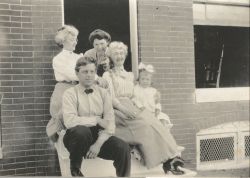
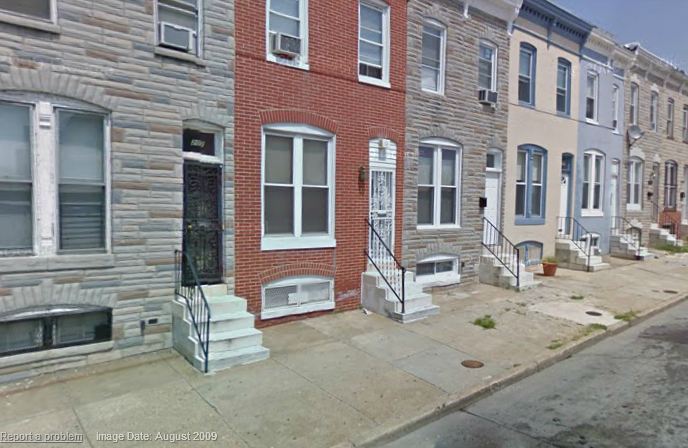
The photograph shows Annie on Memorial Day, 1909. On hundred years ago this month. Annie is on the left, along with her sister Margaret. The caption says: “30 May 1909 – 1911 E. Preston Street, Baltimore. Mr and Mrs. Satterfield, Annie Ray, Margaret and the Cat” Although there is no documentation to verify, it appears that Annie dropped out of the Unity shortly after Dr. Teed’s death. Whether or not she was ever a “believer” could probably be debated. She was a member of that second generation of Koreshans which included the likes of Claude Rahn, Laurie Bubbett, Allen Andrews and others.

Preston Street Today...

Annie lived in several places, including New York City. She apparently stayed away from the Unity for some time as one of the articles in the “Community Current Events” mentioned her visit after a long time away. As far as we know, Annie Ray never married. She died in 1928 at the age of 49 and is buried in the Northwood Cemetery in Philadelphia in the cemetery plot of her aunt, Susan Harmon Webb.


Categories: Monthly Feature.

April 2012

Since 2012 is an election year, we thought it fitting to revisit an election year in Koreshan history. The year was 1906 which became, in some ways, a turning point for the Koreshans.

In his 1978 article in Florida Historical Quarterly, Elliott Mackle wrote:

The removal of Unity headquarters to Estero was in fact a consolidation. Furniture and personal goods of Chicago Koreshans were brought south in carload lots. Printing presses used for the production of tracts and magazines were installed in a print shop near the river and publication resumed. 11 The population
grew to about 200, a peak never significantly surpassed during Dr. Teed’s lifetime. Meanwhile, however, the Koreshans’ relations with nearby property owners, which had been relatively free of friction since 1894, began to change. Neighboring small farmers, alarmed at the influx of people into a sparsely populated district, began to speak out against Koreshan plans to build railroads and elevated boulevards through their fields. As a precaution against interference, therefore, Dr. Teed decided upon municipal incorporation of Estero. A meeting of registered voters and affected property owners was held on September 1, 1904. Incorporation was approved, municipal organization and ordinances voted, and officers, all of them Koreshans, were elected. The town’s corporate limits conformed to plans for New Jerusalem:
110 square miles were contained within Estero’s boundaries. The property of several non-Koreshans who objected to incorporation was not included within municipal limits.

Resistance and opposition to the incorporation from the local press were minimal since, in 1904, the Koreshans had supported the election of Philip Isaacs, editor of the Fort Myers Press, forerunner of today’s Fort Myers News-Press.

Mackle goes on to say:

Dr. Teed’s relations with the press had not been very amicable. Reporters had portrayed him as a pompous schemer and a fraud. Teed often had turned such insults to good account by using them as excuses for playing the martyr in the pages of his own publications. Lee County, however, had now become his base of operations and the home of the Unity. Posturing was easily detected, and laughed at, in a small community like Fort Myers. Prudence was required; he wanted good publicity, and he also wanted treaties, however temporary, with the powerful. Isaacs’s role as editor, coupled with his elevation from town councilman, his last official position, to the bench, must have made him seem an influential person. In fact he was controlled, as were both the Democratic party organization and the newspaper, by the wealthy Hendry family. The treaty between Teed and Isaacs lasted two years. Teed brought disaster on himself, and on Isaacs, by neglecting to form some new arrangement. And Isaacs, like Teed, misjudged the power of his position, thereby contributing to his own undoing. These personal disasters, which accompanied a severing of public ties between Estero and Fort Myers, were occasioned by the events of the election of 1906. The seeds of the conflict had been sown two years earlier. Municipal incorporation had entitled Dr. Teed and his officials to claim a share of county road tax funds, but they found that county officers were loath to divert dollars from their own projects, particularly those in Fort Myers. There was also, in some quarters, a resentment against the northern newcomers who sought to establish what might become a rival county seat, who boasted that they would revolutionize the world and turn it inside out, and who followed a messiah other than Christ. County officials, needing a bargaining chip, looked back to the records of the Democratic primary election of May 1904, when Koreshans had been permitted to register and to vote. 15 In the November general election, however, the Koreshans had voted for Republican Theodore Roosevelt, rather than the Democrats’ nominee. Although the Koreshans had otherwise supported the ticket, this defection provided an excuse to disenfranchise them for the election of 1906. The instrument of this disenfranchisement was a pledge which participants in the first Democratic primary of May 1906 were required to sign if challenged. It stated that the voter would support all Democratic nominees of 1906, and that he had “supported the Democratic nominees of 1904, both state, county, and national.“ Based upon laws passed to deny blacks the franchise, this pledge was so worded as to exclude those who had voted for Roosevelt and those who had not been in Lee County in 1904 and had therefore not voted. The Koreshans stubbornly refused to be intimidated. They appeared at the Estero precinct polling station on the day of the first Democratic primary, protested against the pledge, but then signed it after crossing out certain of the qualifications, and bloc-voted for the candidates of their choice. The Democratic executive committee, of which Philip Isaacs was chairman, thereupon threw out the entire vote of the Estero precinct, including eight votes by the non-Koreshan electors, and instructed election inspectors to bar Koreshans from voting in the second primary. Isaacs and the party had not found it necessary to curry Dr. Teed’s favor. The Democratic candidates for county office could be elected without Estero support, and the Koreshans were ineligible to participate in Fort Myers municipal contests-a bond referendum, an election for town aldermen, in which Isaacs was a candidate, and the elevation of a Hendry to the office of mayor.

When the Koreshans began publication of the “American Eagle”, its main purpose, as stated last month was to oppose Issacs and others in the 1906 election.

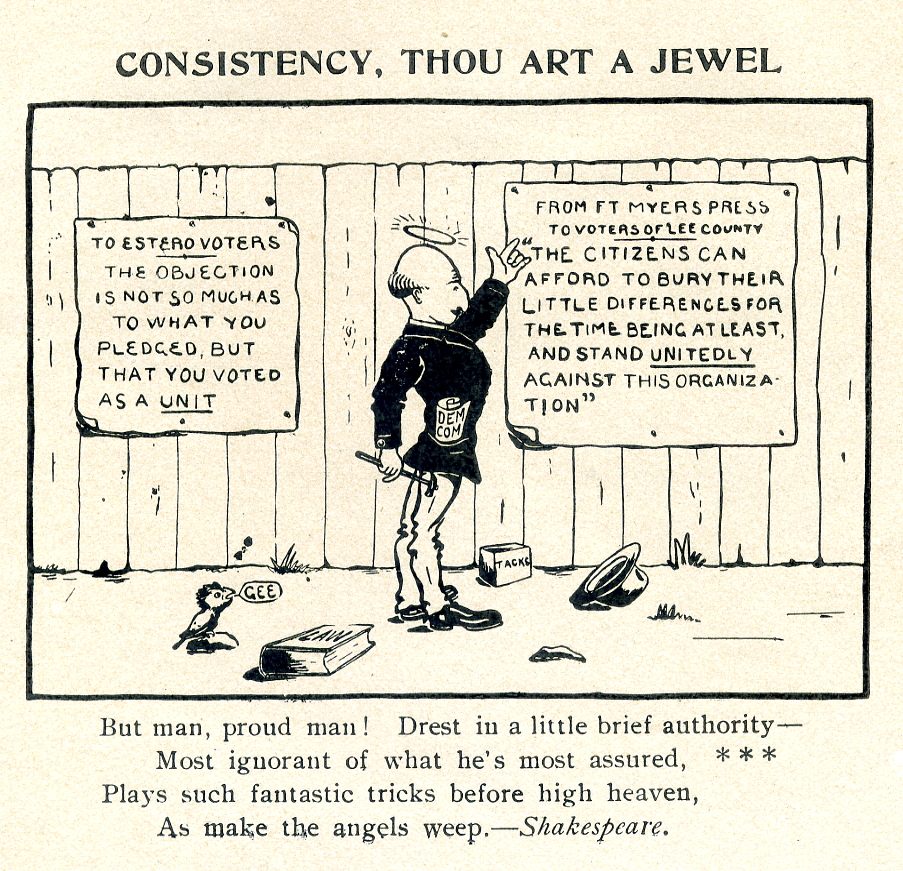
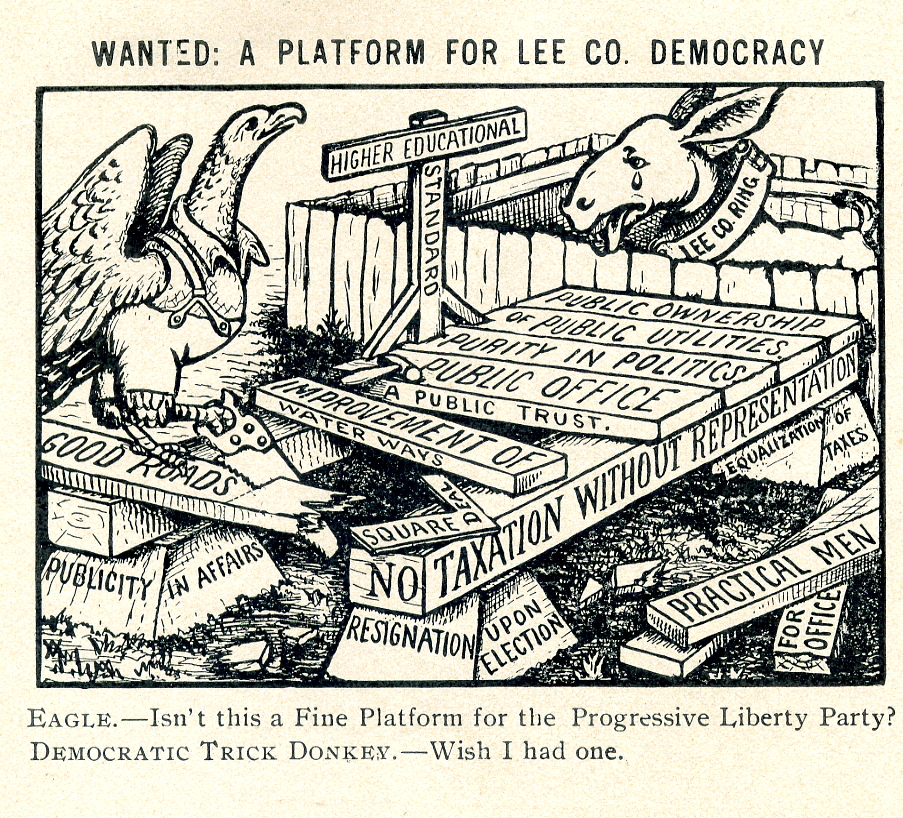
Here are some examples of the political “cartoons” that the Koreshans created. These are contained in a little booklet given to Dr. Teed by Walter Bartsch, a member of the Unity. You can view the entire booklet of cartoons by going to this link


Categories: Monthly Feature.

March 2012

The American Eagle

The “American Eagle” is not so much a reflection of Koreshan history as it is a reflection of what the Koreshans did, or were interested in. When publication began on June 7, 1906, what the Koreshans were doing then, or rather, attempting to do was to influence the elections of 1906. Teed and the Koreshans felt that they weren’t getting their fair share of road taxes and ran a slate of candidates in the election of 1906.

The first issue of the American Eagle was published at Estero on Thursday, June 7, 1906. Thursday, not incidentally, was also the (Fort Myers) Press’s day of publication. This initial edition gave notice that the paper was to be no ordinary country weekly. Printed on sixty to seventy pound book-quality paper, and hand set by Koreshan experts, the Eagle displayed typographical innovations not found in metropolitan dailies until years later, and was far superior in every way to the weekly Florida newspapers of the period. Allen H. Andrews, a printer with no editorial experience, was chosen editor by Dr. Teed, and he was assisted by associate editor Rollin W. Gray. Most of the early articles and editorials were written by Andrews, Gray, John S. Sargeant, U.G. Morrow, and Teed.

American Eagle 1935

Because the Eagle was begun as a means of rallying independents to the political banner of the Progressive Liberty party, the only reference to Koreshan non-political beliefs in the first issue was the motto, “Riches and Poverty Cease where the Commonwealth Begins,” which ran just below the paper’s
nameplate. More expressive of the paper’s early intentions was the wording of the masthead: “The American Eagle: Exponent of Purity in Politics.” The first issue ran four pages, and the editorial content was almost entirely politically partisan. The tone was set in the lead-off editorial: “As heat is one of the
necessary factors in incubation, so from out of the heat of the recent political strife has been hatched The American Eagle, full-fledged and strong of beak. His flight is lofty-no place, though high, escapes his keen, far-seeing eye. From time immemorial the eagle has been the symbol of liberty from the thraldom of the oppressor’s yoke, therefore The American Eagle – friend of the downtrodden and oppressed-is an adversary to be reckoned with by those who `are thirsting for power’ and dominion over others.”

With this being an election year, there will be more on the election of 1906 in future columns, including some of the political cartoons. The archives collection of the American Eagle is rather slim. The issue above, from 1935 is our oldest copy with the bulk of the collection being from the revived Eagle which was published after 1965. See the listing in our Online Archives. You can also read the Elliott Mackle article from the 1978 “Florida Historical Society”

Categories: Monthly Feature.

February 2012


From the Koreshan Archives:
FEBRUARY

 • Note: The ‘online’ archives database has been updated and now includes more scanned items than ever before. This project continues as we hope to have everything digitized at some point…

 —  I’ve published this photo before… probably a number of times, but it never ceases to amaze me! Anyone who has ever been to the State Historic Site can get a feel for this shot, which was probably taken from the north side of the Estero River. The building, known as the Art Hall, was built about 1905. It was the center for cultural, social, educational and religious activities of the Koreshan settlement. Theatrical productions, lectures and musical events were held here. The building housed paintings done by Douglas Arthur Teed, son of Cyrus Teed, as well as paintings done by members of the Koreshan Unity. The stage of the Art Hall used to hold original instruments from the Koreshan Band and Orchestra which performed here.

Art Hall - Click for a larger image

This photograph, from over 100 years ago, shows us the stark reality of the landscape in Estero at that time. You will notice that there is no US-41, nor any road for that matter. This view, looking south, shows us no Melaleuca trees devouring the landscape either. This photos, once again, reminds us that the Koreshans were true pioneers in every sense of the word. (Click on the photo for a larger view).
[Photograph from the Ritter Collection]


    February Birthdays:

  • Jesse Putnam (1869-1950) – February 5
  • Henry Silverfriend (1864-1949) – February 6
  • John A. Grier (1855-?) – February 20
  • Douglas Arthur Teed (1860-1929) – February 21
  • William McCready (1854-1926) – February 21
  • Emma G. Fiske (1856-1931) – February 27

Categories: Monthly Feature.

Tags: ,

Ghost Walk

Here is some information from the “Official” Koreshan State Park website about the upcoming “Ghost Walk”. You can take a look at ALL the upcoming events by visiting the Official Web Site of the Koreshan State Historic Site.

The “Ghost Walk” has become one of the most popular events of the year. Here are the particulars for the first of two Ghost Walks this year. (The other is February 3, 4).

GHOST WALK
Koreshan State Historic Site
Date: January 27 & 28, 4 walks per night at 7, 7:15, 7:30 and 7:45 PM

Description:
Voted #1 interpretive event of the year throughout the state.
Candle light walk through the historic settlement. This is completely rewritten for those that have attended before. Experience some moments in the lives of the Koreshan pioneers and the heritage of the Historic Site.
Space is limited, reservations are required.

Participation Requirements
Fees: $10 per person
Contact: Call (239) 992-0311

Directions:
I-75 Exit 123 Corkscrew Road, head west 2 miles, cross U.S. 41 and continue on Corkscrew Road approximately 1000 yards to entrance of park. If traveling U.S. 41 (Tamiami Trail) Koreshan is located at the intersection of U.S. 41 and Corkscrew Road at Estero.

Travel Advisory:
Due to construction commencing in Mid January 2011 and continuing until Late March 2013 to widen US Highway 41 from Corkscrew Road to San Carlos Blvd. visitors to the park should plan for delays when traveling north or south along US 41. Coming from I75 there may also be delays in crossing US 41 at Corkscrew Road. For more information or comments about this work please contact Kris Cella, Cella Molnar & Associates, Inc. 239-337-1071, Kcella@cella.cc or Debbie Tower/JoAnn May, FDOT: 239-461-4300, Debbie.Tower@dot.state.fl.us JoAnne.May@dot.state.fl.us

Categories: Posting.

January 2012 – More Construction…

Last month we described some of the history of US-41 as it relates to the Koreshans and to Estero. This month, we want to look back at more of that history.

The “American Eagle” carried a front page article in their April 1978 issue, entitled “We The People: Highway 41 – the TAMIAMI TRAIL – calling:[ref]The American Eagle – Vol-57, No-156 – April 1978[/ref]” It read…

Twenty-two years ago the Florida Department of Transportation bought the land necessary to finish the eastside of Highway 41 from the property owners in Estero. The westside had been finished, the mere 4.8 miles to follow. Property owners had to close their businesses on the unpaved stretch to wait for DOT to finalize the deal.

Now, with the Florida Department of History planning a “Williamsburg” in this area, without even owning all the land they included, the federal Department of Transportation was told not to spend the money on the four-laning on Highway 41 through Estero, just turn the clock back — back to where?
What do the property owners say to that? In a public hearing in November 1977 95% protested against such breach of trust. Did 95% convince the history department of the people’s voice? NO, the opponents still pursue their plan to build a western route and retire the original Tamiami Trail to county level or to the pioneers cow trail.
More hearings, more meetings, more travel of officials have to be financed by the taxpayers so “Williamsburg” can get off the drawing board.
VOTERS, TAXPAYERS, PROPERTY OWNERS, TRAVELING PUBLIC — aren’t WE THE PEOPLE? If you drive over this unfinished stretch of Highway 41 you will be convinced that your representatives need to be called for supporting the final four-laning, long overdue. Let your representatives know that you oppose the fact that several millions of dollars should be expended to build the western alternative, while only a fraction of this expense will finish the desparately needed Highway 41 through Estero — a stretch unusable for any other purpose than four-laning. TRAVELERS, VOTERS, TAXPAYERS, PROPERTY OWNERS — express your opinions NOW. Support the two Bills of A. L. “Skip” Bafalis-R, and Richard Stone-D, now pending in Congress. Future generations will thank you for your action while your indecision will burden them. Don’t neglect your duty.

More information followed in the next issue when the American Eagle carried an article about the “Trailblazers”, the group, which included four Koreshans, who made an expedition across the Everglades to Miami in the 1920’s. The article was headlined with “Shall a Dream become a Nightmare?”. Following this was an article from the Fort Myers News-Press:[ref]As Published in the American Eagle, Vol-58, No-157 – May 1978[/ref]

Ft. Myers News-Press Editor’s Opinion U.S. 41 EXPENSES NEEDLESSLY RAISED
Block-headed historical preservationists have put the state into a bind, where the cost of four-laning U.S. 41 at Koreshan Unity State Park will be considerably higher regardless of the road.
We strongly urge Congress to override the decision of federal historic preservation officials by passing a law permitting 41 to be four-laned along its current route at that point. Sen. Richard Stone and Rep. L. A. “Skip” Bafalis have bills in both houses to do that.
Members and officers of Koreshan Un’ity, as well as Estero residents, have repeatedly asked that the present alignment not be changed. The highway, they insist, will in no way harm the Koreshan Unity Settlement or any of its historic character. Yet at the blind urging of Florida Historic Preservation Officer Robert Williams, the federal Advisory Council on Historic Preservation has ordered the highway moved east or west to avoid proximity to the settlement.
The cost of a new route would be millions of dollars higher and might also run into objections from environmentalists, further delaying construction.
Escalating construction costs during the delay are already eating into the funds allocated for the job, and state Department of Transportation officials have been forced to choose a site three-fourths of a mile west of the present route — to the western edges of the park — so that land can be bought and’ design of the highway can proceed.
If congress succeeds in overriding the historic preservationists, the money put into the new alignment will be lost, but that will be cheaper than further delay, state road officials say.
Congressional action is urgent to prevent any more wasted time and money.
Reprint — Fort Myers News-Press

Obviously, the Koreshans, which by this time was Hedwig Michel, were obviously not in favor of moving US-41 to the west. In a following issue of the American Eagle [ref]American Eagle, Vol-58, No-163, November 1978[/ref] Hedwig continued to push for the four-laning through Estero while also attmepting to protect the historic areas.

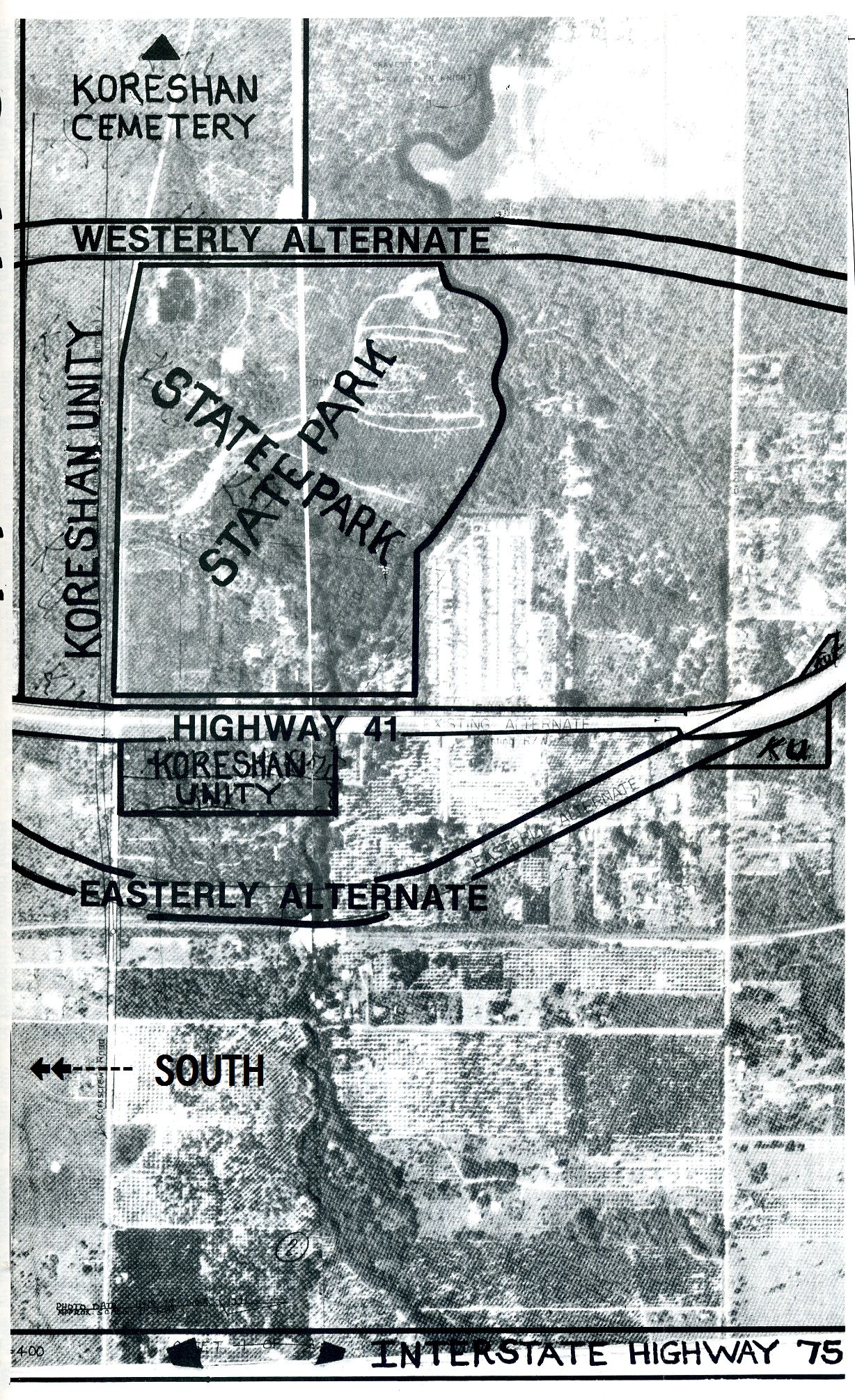
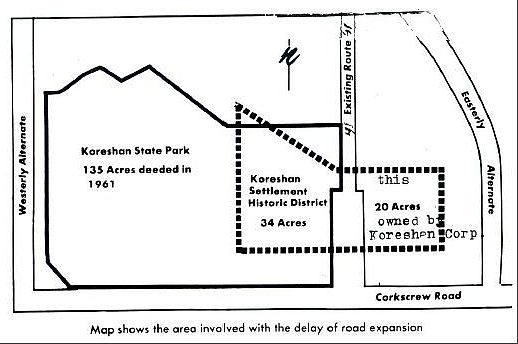
Here are two maps (click on the link) showing an aerial view with the proposed routes and a second map showing a drawn map.
Click here for Map #1
click here for Map #2

More next month…

Categories: Monthly Feature.

December 2011 – Construction…

We’ve mentioned it here before, but this year there is MAJOR construction on US-41 which has a major impact on business in the area as well as on the State Park.

How this all relates to Koreshan history goes back to the very beginning when the “Trail” was nothing more than that. In the intervening years the path has become part of a major highway that stretches from the east coast of Florida to the upper peninsula of Michigan.

In the 1920’s when the “Tamiami Trail” was completed, this created a source of income for the Koreshans who made money by opening the store which was about the only place for goods between Fort Myers and Naples.

US-41 has undergone any number of enlargements and enhancements. When expansion was done, construction came within a few feet of the “New Store” and necessitated the removal of the canopy and part of the facade of the building. In the 1970’s the area was put on the “National Register of Historic Places”, which made any infringement onto the land designated as “historic” forbidden. This complicated matters even more.

In 1979 a controversy grew when a group calling itself “The Committee for Four-laning U.S. 41 Along its Present Alignment”. The Naples Daily News wrote about in in 2009 in their “Thirty Years Ago This Week” column.

Citizens banded together 30 years ago to form an organization with a very long name and a specific mission: to get U.S. 41 four-laned through Estero along its existing route.

The non-partisan group of 15 people from Bonita Springs, Estero and San Carlos Park was named The Committee for Four-laning U.S. 41 Along its Present Alignment.

Members planned a multi-pronged assault that included a letter-writing campaign to officials, a petition drive, legal action and a call to oust a state official who was holding up the four-laning.

“This is one chance for all the people of this area to unite in something that concerns us all,’’ said Bonitan Walter Shikany.

The new group was determined to overturn state and federal rulings prohibiting the four-laning along the existing route, where right of way had already been purchased. The alignment glitch stemmed from the designation of the Koreshan settlement as a federal historic site, after the right of way was bought. The designation prohibited highway construction next to historic sites because of possible adverse affects. State and federal officials were recommending an alternate, westerly route that locals were against.

Committee member included Irv and Pearl Glucksman, Finis Burkhardt, Anthony Palone, Herbert Blakeman, Ruth Mason, Jo Harper, Minnie Cox, Vesper Egnew, many of whom were pictured recently in a Remember photo in The Banner.

Another meeting was planned for Feb. 26, 1979.

There was talk about routing US-41 to the east of the Historic Site and State government got involved with the widening becoming an issue in the election of the Florida Secretary of State.

Next month, we hope to have some articles from the “American Eagle” which highlight the controversy.

Suffice it to say, once again, the area is experiencing another change.

Categories: Monthly Feature.

November 2011

Everyday life in the Koreshan Unity… Here is the December 1922 (describing life in November 1922) “Community Current Events” in its entirety.

CURRENT EVENTS IN OUR COMMUNITY
Some Political Issues Decided; an Enjoyable and Varied Program “Was Given Thanksgiving Night
BY D. J. RICHARDS
December 1922
—————————————
THE COUNTRY’S ATTENTION has been riveted during the past month on candidates and election results, and it was no less so with us here in this southernmost part of the United States, only ours was more local than national. The principal issue to be decided here was whether the people of Lee County were in favor of county division at this time. There was considerable dissatisfaction over the successful candidate in the primary, so much so than an independent candidate came out to contest the election, over the issue of county division, but the results were unmistakable, the majority favored it. So this issue will undoubtedly be enacted into law at the coming legislature and Hendry County will become a reality, with LaBelle as the county seat.
Another issue which caused considerable dissatisfaction was that of county commissioner for district number three. There is only one party, practically speaking, in Florida, and that the democratic. A candidate winning in the primary is almost equivalent to his being elected. But. this year the unexpected happened, the defeated primary candidate, besides many others who seemed to be in a position to know, preferred charges of gross irregularities against the successful candidate over the way things had been con- ducted at Naples, and the matter was taken before the judge of this district, but the judge, for some reason or other, refused to allow the ballot box to be reopened. The name of Mr. A. M. Smith, the defeated primary candidate, was again placed on the ticket to run against Judge Wilkinson, the present incumbent, and we are glad to state that Mr. Smith won by the small majority of seven votes. Estero is situated in district number three, and we supported Mr. Smith, both in the primary and the general election, and we believe he will make a conscientious officer and will devote his energies to the best interests of all concerned.
It is customary in the Unity to hold a caucus the night before the election, to inform ourselves as to the merits and demerits of the candidates up for election and decide whom we will support. After reaching this decision, our vote is cast as a unit. So in a close race the Unity vote is a deciding factor, which emphasizes the axiom that “In unity there is strength.” The Koreshan Unity cast fifty-seven votes in the last election. Dr., Price was chosen to act as chairman of our caucus, a position he is eminently fitted for, and in his jolly manner the business was transacted with dispatch and good order.
In “Reasons for Thanksgiving,” by Moses Folsom in the Jacksonville Times-Union of Nov. 26, we read that: “President Washington issued the first Thanksgiving proclamation while the capital of the nation was in New York.” This, we are told, was done the third day of October, 1789. The thought occurred to us, of all the people in the world today that can be truly thankful, none can claim more than Koreshans for having found the absolute truth as revealed to us through our beloved Master and exposited in his wonderful Science of Universology. The last Thursday of November of each year is set aside as a national holiday; but inasmuch as we are grateful to Him, not one day in the year, but the entire 365, for what he has done for us, we observe it like any other (with emphasis on the Eighteenth of October, the Master’s Natal Day) in the performance of use to the neighbor. However, the matron stressed the point in the pro-visions, of the day, and in the evening a merry entertainment was given in the Art Hall, in which dull cares had no part.
The opening number was “The Landing of the Pilgrims.” Sister Berthaldine Boomer read extracts from the November Mentor of the landing of the Pilgrims at Plymouth Rock. At the conclusion of her reading the stage curtains were drawn, revealing a tableau portraying the landing. A benediction was offered and songs sung by the Pilgrims in thanks for their safe arrival. This; number was a winner, and many wished a flashlight picture could have been taken of it.
Two humorous short plays were enacted, the first being Maud E. Hall’s “The Scrubtown Sewing Circle’s Thanksgiving.” The cast was: Sisters Rose Gilbert, Ella Graham, Bertha S. Boomer, Florence Graham, Bertha M. Boomer, and Barbara Ehrisman, and each did their part well. This play was hilariously funny and concluded with the following in concert.
“We know we are guilty of shamming ’tis clear,
We feel not so old as we’ve tried to appear,
But just to amuse you ’tis surely all nght,
And so we will wish you good night.
The other play was entitled “The Physical Torture Club,” by W. N. Bugbee. The cast represented a family by the name of Bangs and the parts were taken by Dr. James Russell Price, Mrs. Price, their grandson, Harl Price Cook, and Sister Edna Schwmdel. The daughter (Sister Edna) was what might be called a “physical culture crank” and was very anxious for her brother to follow in her footsteps, so they performed their exercises, but the boy ..was too mischievous to make much headway. The father, who was terribly afflicted with rheumatism, wondered if these exercises wouldn’t help his rheumatism, and after a little urging decided to give them a trial, the whole family taking part. From this to the end the play was a scream- in more senses than one; needless to say all four played their part as if they were professionals, to the merri- ment of all present. Other interesting numbers were the children’s humorous recitations and song, accompanied by their teacher, Sister Marie Fischer, on the guitar. All that could participated in the grand march. Next was two quadrilles, the first one by eight sisters, and the second one all brothers, both under the direction of Brother William Fischer. The orchestra played a number of selections during the evening. The entertainment came to an abrupt, but very humorous, end when the lights went out before the last dance was finished. This joke, if intentional, was enjoyed as much as any, all retiring after spending a most enjoyable evening.
Our boat, “The Estero,” which has been on the ways for needed repairs, was recently launched and made the first run to Fort Myers in many months for the purpose of inspection by government officials, as required by law; it returned with a cargo of provisions for the Unity store. The fruit crop in Florida this winter is most excellent. This year the Flower Grove is shipping their fruit by truck, as are many other shippers. However, “The Estero” has been booked to haul fruit from a number of groves here.
We have gone as far as we can for the time being with our new power house. The cement floor was laid recently. The engine after a few additional fittings, is ready to turn over; the auxiliary engine with air tanks for starting purposes is now installed and ready for business, but a circulating water tank will have to be erected besides putting on belting and other accessories before the plant will be ready for operation. These will come in due time.
What child doesn’t thrill over a circus? and many grown-ups, for that matter. Well, we are glad the children of the Unity, through the kindness of Mrs. Edith Trebell, saw Sparks’ circus that came to Fort Myers recently, and all report having had a most enjoyable time.
Mrs. C. Newcomb and daughter from Colorado are guests this winter at the Campbell home in Estero. Mrs. Newcomb is a sister of Mrs. Campbell, and at one time was an active member of the Unity.
Mr. Louis Bessemer, of Washington, D. C., recently made the Unity a two days’ visit. .Having spent many of his boyhood days in the Unity, he returned to it with much enthusiasm and was delighted to meet our people again. He represents the Radcliffe Chautauqua organization, with headquarters at the national capital. His love for Koreshanity is greater than ever and he said Estero is the apex of the thought world. His work brings him in contact with the fore-most business men of the cities he visits and whenever the opportunity presents itself he proclaims the great work carried on at this center. His coming to us at this time was most refreshing; the only fault we found was that his stay was entirely too short.
Lili Lehman, in her book “How to Sing,” says: “The true art of song has always been possessed by such individuals as are dowered by nature with all that is needful for it—that is, healthy vocal organs, uninjured by vicious habits of speech; a good ear, a talent for singing, industry, and energy.”
It was our good fortune, in company with a number of other brothers and sisters of the Unity, to listen to an artist possessing the above qualifications. The artist in question was Miss Helen Davis, who, in company with Mr. Victor Young, composer-pianist, gave a “Joint-Recital” with the Edison Re-creation Phonograph, tendered to the music lovers of the county by the Parker Book and Music Store of Fort Myers, Fla., at the Gwynne Institute on Wednesday evening, Dec. 6.
Mr. Young made a few preliminary remarks about some of the wonderful things Mr. Edison had contributed to humanity, and stated that for years Mr. Edison had cherished a desire to produce a phonograph that would re-create the human voice, and that he and Miss Davis were there that evening to demonstrate to the audience the success of the invention, they to be the sole judge. He stated also that of all the instruments to re-create the most difficult was the piano, and the test would be more with the voice than with the piano.
Miss Davis’ first two numbers were: (a) “The Quiet Road” by Speaks, (b) “No Sir!” by Wakefield, and there it was; singing with records of her own making, blending perfectly without a perceptible dif- ference, with the exception of the movements of her lips. She sang five more -numbers with the phono-graph. For a moment during one of the numbers the lights were turned off, and when turned on again there was no singer on the stage, but the effect was just the same, proving unquestionably that Mr. Edison almost had made the impossible, possible,—that of re-creating the human voice.
Mr. Young, likewise, accompanied records of his own making: (a) “Little Shepherd” by Debussy, (b) “Crescendo” by Lasso, and (c) “Improvisations of Old Songs,” his own composition, and several other selections. We have already stated the difficulty of re-creating the piano, but nevertheless the artist’s playing was scarcely perceptible with the record. The thing that impressed us most in the performance, however, was the consummate skill of the artist, every movement and touch synchronizing with the record. It was truly an event, as both were artists of the first magnitude.
The program concluded with two selected groups of songs by Miss Davis without the phonograph, accompanied by Mr. Young, and two selected numbers by Mr. Young on the piano. In these the artists were not restrained, but everything ad lib. We don’t recall the titles of their selections, but it will be some time before the effect produced will be effaced .from the memory. Miss Davis has a rich, flexible mezzo-soprano voice, also perfect diction, with all the delicate gradations possessed by the best artists. We can only think of the artists’ mission to Fort Myers at this time in the words of the poet:
“0 Music! sphere descended maid,
Friend of all pleasure, wisdom’s aid.”

Categories: Monthly Feature.

October 2011

From the Koreshan Archives:
OCTOBER

Just as last month marked the birth of one of the lesser known Koreshan, this month marks the birthday of one of the most prominent Koreshans — “Professor” Ulysses Grant Morrow, the man who “proved” the Cellular Cosmogony. The KSHS Archives has numerous references to Prof. Morrow. He was born in Kentucky and later moved to Missouri. It is unclear when or where he joined the Koreshans, however, the Rahn Membership List shows the following: Ulysses G. Morrow; Born: 26 Oct 1864 in Barren Co., Kentucky; as a boy moved with his parents to Unionville, Missouri, in 1885. He had a Ph.D. from “College of Higher Science,” Chicago; withdrew from the K.U. at Estero, January 31, 1909, about a month after the death of Dr. Teed, in December 1908. This resignation must have actually taken place earlier than that, however, since the Flaming Sword of December 15, 1908 mentions tht changes will be taking place in the publication due to “the resgination of Professor Morrow… While he belonged to the Unity he authored part of the book The Cellular Cosmogony as well as editing the Flaming Sword and the Salvator and the Scientist. However, when he eventually came to a disagreement with Dr. Teed and he left the Koreshan Unity, his writings remained in the book, only without credit. Writing to a Koreshan in 1938, Morrow said:

“When I withdrew from the Koreshan work, I made this declaration… ‘I will follow no man…” He also said “I have nothing to say against him. (Teed) …I became conscious of the fact that he was losing that high conception (of righteousness) and was failing in various ways, as his last few years fully attest. …If I passed him in progress, it was his fault”

He also said that when he left he took bound copies of all his writings, but later discarded them because of his desire to begin anew. He worked as a linotype operator in order to make a living. Morrow died in New Orleans on September 11, 1950.

Categories: Monthly Feature.