From the Koreshan Archives —
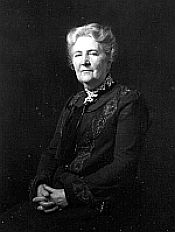
This month we find the birthday of a Koreshan who rarely gets mentioned, but one who contributed a great deal to the cause of the Unity. I’m speaking of Nancy Cornelia Hawes Critcher She was born July 26, 1842, (please note that our genealogy pages show her birth in 1841. This has not yet been corrected) in Norwich Connecticut. She died on 11 October 1917. She was the youngest of four children born to Madison Hawes and Nancy Nelson Dam.
When she was 9 years old, she traveled with her mother to California. The three month ocean voyage around the Horn brought them to San Francisco in 1852 where they joined Nancy’s father, Madison, who had made the same trip in 1849. At this time Nancy was the only surviving child of Madison and Nancy. They lived on Taylor Street between California and Pine in San Francisco. Nancy went to a private school, to a Mrs. Purkitt, and she graduated from the Bush Street Denman School in San Francisco at the age of 12.
When she was almost 15 years old, on July 1857, she married Henry Critcher in San Francisco. Henry and Nancy lived in San Francisco from 1852 to about 1864 when they moved with her father, Madison, to the Octagon house in Brooklyn (now Oakland) in the East Bay.
They lived there until sometime after the 1868 earthquake during which the house was badly damaged. Henry and Nancy and their children returned to San Francisco where they lived in the home built in 1854 at the corner of Taylor and Pine. Henry died there in 1904. The house was destroyed in the earthquake and fire of 1906, and later that year Nancy joined the Koreshan Unity.
She was on the editorial staff of “The Flaming Sword” and was considered to be one of the best posted writers in Scientific religion in the United States. Her death was caused by an accident when she fell and broke several bones. She retained her mental faculties until a few hours before she died. She was buried at the Horseshoe Bend Cemetery.
Writing in “Folks We Knew in the K.U.” Marie McCready wrote that Cornelia Critcher: “Had an almost bass voice; was for a short time caretaker at the children’s cottage in Estero; was the mother of around a dozen children.(–Rosalea McCready) I remember somebody asked her why she did not live with one of her children and she replied that they all had big families, and children’s activities were too much for her.”(–Marie McCready.) She did, indeed have 14 children, born from 1858 thorugh 1880. She wrote a number of articles for the “Flaming Sword
Here are some excerpts from Nancy C. Hawes Critcher’s letters:
Estero, December 28, 1906; Dear Children: The sisters wear a kind of combination corset cover and skirt, which takes the place of the usual skirt and is cooler than wearing so many garments. Moreover, as each one does her own washing and ironing, it is very desirable to have as few pieces as possible! They should be made of some thin material, not necessarily very fine. I suppose you know what thin material will wear best as you have lived in a hot climate so long…….You asked me to describe my room, etc. Everything here is very primitive and pioneery; the rooms are in dormitory fashion divided by sheets…..I have a very pretty little dresser that I bought in Chicago, and a single iron bed – a nice little rocker and the usual toilet articles, and am very comfortable….We quite often have visitors……I need a little money to supplement the diet, which is sometimes not quite up to the standard, especially in sweet things, which you know I am very fond of.
Estero, August 6, 1907; Dear Grace: ….I never knew time to fly so fast. I help in any way that I can – principally in the sewing line. Then I think I told you that, for a novelty, I preside (?) over a table of boys. I wish I could send you a photo of some of the features of the place. We have some beautiful bamboo trees and China Berry trees. The park is really beautiful.
LETTER, May 4, 1917; written to Grace V. Critcher Belshaw from Nancy Cornelia Hawes Critcher (signed “Mother”): Nancy tells about life in the settlement:
Estero, May 4, 1917; My dear Grace: ….You ask about our membership here and the work…We have about a hundred brothers and sisters here, (have not the exact numbers) and work of many kinds is carried on. We have a very well equipped printing establishment, where our two papers, The Flaming Sword and The American Eagle are published. The Sword is our religious and scientific magazine, a monthly, and the Eagle, a weekly secular paper, absolutely independent of politics, and advocating all measures for the public welfare….The printing office also does job work for outsiders, besides printing our own tracts and leaflets. We have a saw mill, carpenter shop, machine shop and an electrical shop; also a laundry where all who wish can have their washing done. Many, however, myself among the number, prefer to do their own; the ironing of the sisters’ things is done by themselves. I have become quite an expert laundress! We have an agricultural dept, and a dairy, which supplies milk for the family; pigs and fowls, dogs and cats! Our park is greatly admired by visitors; it is the finest in the county. The recent freeze did a great deal of damage to our ornamental shrubbery, and some of the less hardy trees, but the general effect is as good as ever. I miss the fruit of California. The semi-tropical fruits such as guavas, mangos, papaws, etc. do not suit my taste like the pears, peaches, plums, etc. of the old time. But as I did not come here for the luxuries of the palate, I do not complain. I am satisfied that this is the best place for me, where all are agreed upon the religious plane, though still showing all of the human frailties on other lines! I read the articles in your papers, and found many good points in them. Where we differ fundamentally, however, is in our estimate of the Lord Jesus, who, to us, is all the God there is. We take for our standard the first chapter of John’s gospel which makes that fact very plain. Our life here hinges entirely upon our belief in the fact that uses to the neighbor are the real test of all religion. Love to God and the neighbor is shown by the performance of uses of daily life, done unselfishly from love. That is the aspiration, not always successfully carried out, but always the aim. To return to the enumeration of our equipment, I find that I failed to mention two very important items, our boat and autos. We have two autos and many boats. One, a large freighting a passenger boat, runs to Ft. Myers three times a week, as a common carrier for the neighborhood. The others are used between our Mound Key place, and Estero Island, both for pleasure and service. On Mound Key our vegetables are raised by a brother who lives there, and the Island is very much appreciated as a place of rest and recuperation. A brother lives there, also, and raises vegetables and chickens, besides keeping the place in beautiful order. There is fine salt water bathing to be enjoyed there, also……..We have in the river any amount of oysters, to say nothing of some very fine fish among which are mullet, which I consider as fine as any fish I ever ate with the sole exception of salmon. I believe I have now pretty well covered the subject of our numbers and resources. None of them are developed to the limit of their possibilities, because we have not enough men to fill so large a requirement. This reminds me that I have not told you much about the work of the sisters. The sisters and the children of whom there are ten, do the dining-room and dish-washing work; they, also (not the same ones) do mending for the brothers, and others sew for such of the sisters as cannot do their own. One sister makes shirts and overalls very expertly. Others make sheets and bed screens, etc. Many of the sisters are like myself……and cannot do very strenuous work, although not by any means deficient in power to do mental work. Our old ladies would be a credit to any Old Ladies’ Home! The brothers, as a rule, are nearer middle age.
OBITUARY; Mrs. N. C. Critcher (Newspaper and date omitted):
Mrs. Nancy Cornelia Critcher, relict of the late “Forty-Niner,” Henry Critcher, known as the Admiral, who was one of the organizers of the San Francisco Stock Exchange, died today October 11, 1917, at the Koreshan Unity, located at Estero, Florida, a religious organization founded by the late Dr. Cyrus R. Teed. Mrs. Critcher was on the editorial staff of “The Flaming Sword,” the organ of the community, and was considered by those who knew her, to be one of the best posted writers on scientific religion in the United States. She left a family of seven sons and four daughters,–Mrs. Charles H. Crowell, living in Spain; Mrs. Grace V. Belshaw at Antioch; Mrs. Virginia C. Brittson at Vallejo; Mrs. Reginald Atthowe of San Anselmo, all in California, and a granddaughter, Mrs. Engracia F. Freyer, wife of Lieut. F. S. Freyer of the United States Navy, of Washington, D. C. One of her sons, Edward Payson Critcher of the Chicago Herald, was at her bed-side when she passed away. Her death was caused by an accident several weeks ago, when she fell and broke several bones. She never recovered, but retained her mental faculties until a few hours before she died. She was buried at the Koreshan Unity Cemetery at Estero. She was 76 years of age, and lived in San Francisco from 1852 until 1905, when she moved to Estero, Florida.
 Koreshan Unity home in Chicago, Illinois on March 9, 1899. On his mother’s side, he was directly descended from John Read who came to America in 1630, settling in Rehoboth, Massachusetts. His great grandmother Lydia married the Reverend Oliver Tuttle of Bristol, Connecticut. His mother, Sarah Ann Tuttle was born on October 27, 1815 in Bristol, Connecticut and died at Moravia, New York, October 25, 1885. Shortly after Cyrus was born, the family moved to New Hartford, New York on the land of grandfather Oliver Tuttle. At the age of eleven, Cyrus quit school and went to work on the tow path of the Eire Canal. His family wanted him to become a Baptist minister like his grandfather Tuttle, but Cyrus chose to follow another relative and began studying medicine with his uncle, Dr. Samuel F. Teed ( a twenty-five year old allopathic physician) in Utica, New York. At this same time on April 13, 1859, he married his second cousin, Fidelia M. Rowe of Merideth, New York. Delia was the daughter of William and Polly Maria Tuttle Rowe.
 Ulysses G. Morrow; Born: 26 Oct 1864 in Barren Co., Kentucky; as a boy moved with his parents to Unionville, Missouri, in 1885. He had a Ph.D. from “College of Higher Science,” Chicago; withdrew from the K.U. at Estero, January 31, 1909, about a month after the death of Dr. Teed, in December 1908. This resignation must have actually taken place earlier than that, however, since the Flaming Sword of December 15, 1908 mentions tht changes will be taking place in the publication due to “the resgination of Professor Morrow… While he belonged to the Unity he authored part of the book The Cellular Cosmogony as well as editing the Flaming Sword and the Salvator and the Scientist. However, when he eventually came to a disagreement with Dr. Teed and he left the Koreshan Unity, his writings remained in the book, only without credit. Writing to a Koreshan in 1938, Morrow said: “When I withdrew from the Koreshan work, I made this declaration… ‘I will follow no man…” He also said “I have nothing to say against him. (Teed) …I became conscious of the fact that he was losing that high conception (of righteousness) and was failing in various ways, as his last few years fully attest. …If I passed him in progress, it was his fault” He also said that when he left he took bound copies of all his writings, but later discarded them because of his desire to begin anew. He worked as a linotype operator in order to make a living. Morrow died in New Orleans on September 11, 1950.

 had a major impact, at least on the infrastructure of the Unity. His name was Richard Jentsch, born in Germany on the 8th of June, 1883. He came to Estero in 1906. It is unclear how long before that time he had been a member of the Unity.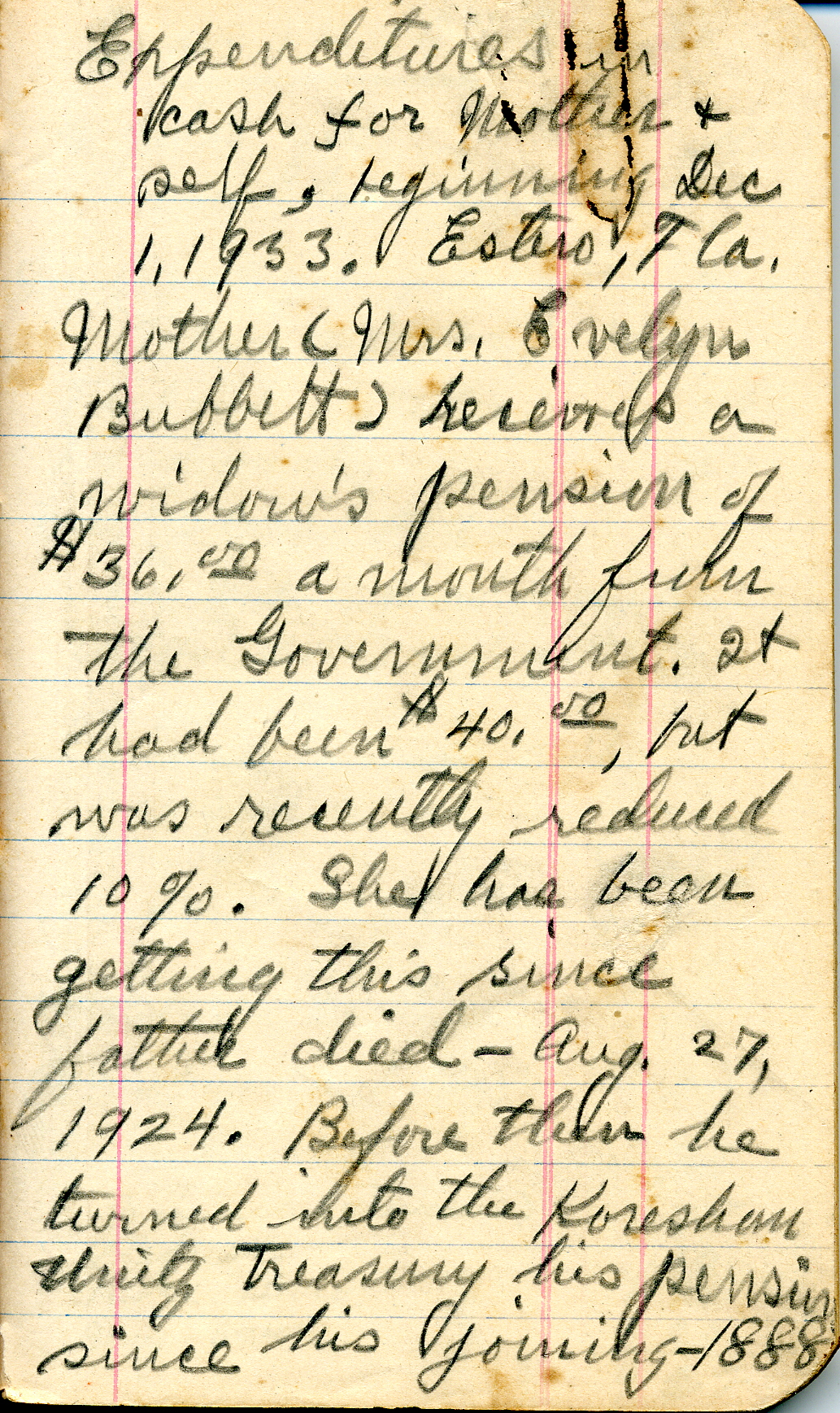


.jpg)