Skip to content

February 2011

From the Koreshan Archives:  —  February brings us a photograph that we did not see until just a few years ago. This photo is the Art Hall. The building, which has been restored, was built about 1905. It was the center for cultural, social, educational and religious activities of the Koreshan settlement. Theatrical productions, lectures and musical events were held here. The building housed paintings done by Douglas Arthur Teed, son of Cyrus Teed, as well as paintings done by members of the Koreshan Unity. The stage of the Art Hall used to hold original instruments from the Koreshan Band and Orchestra which performed here. Once the restoration is complete, the curatorial staff at the Park will be attempting to make the inside look like it did in the time of Teed.

Art Hall - Click for a larger image

This photograph, from over 100 years ago, shows us the stark reality of the landscape in Estero at that time. You will notice that there is no US-41, nor any road for that matter. This view, looking south, shows us no Melaleuca trees devouring the landscape either. This photos, once again, reminds us that the Koreshans were true pioneers in every sense of the word. (Click on the photo for a larger view).
[Photograph from the Ritter Collection]


    February Birthdays:

  • Jesse Putnam (1869-1950) – February 5
  • Henry Silverfriend (1864-1949) – February 6
  • John A. Grier (1855-?) – February 20
  • Douglas Arthur Teed (1860-1929) – February 21
  • William McCready (1854-1926) – February 21
  • Emma G. Fiske (1856-1931) – February 27

Categories: Monthly Feature.

In the News (1953)

In my last posting, I mentioned some sources for Koreshan research. I mentioned the misnomer of the website Old Fulton New York Post Cards.

Here is an example of the interesting things that can be found online. This article (you must have a PDF reader to view it) is from the Binghampton New York Press, Thursday, April 2, 1953. That was, of course, long after Teed had died and the Koreshan Unity was, by this time, in decline.

The gist of the article is that Teed was being looked at as a locally produced novelty.

You can view the article by clicking on this link: Binghampton Press April 2 1953

Categories: Posting.

Researching the Koreshans

There are any number of sources for researching the Koreshans, Cyrus Teed and others. Some of these online databases charge for access, but there are a good number of sources that are free to use.

I recently ran across a couple of places where you can search for old newspaper articles. The first is the Library of Congress which has a section called Chronicling America. This section of the Library’s site covers the years 1860-1922, and includes papers from about half the states, including California, District of Columbia, Florida, Kentucky, Minnesota, Nebraska, New York, Texas, Utah, and Virginia.

Another web site, which may not have caught the eye of many people is a site called Old Fulton New York Post Cards. Post cards? Well, they are much more than post cards. This site has an extensive collection of newspapers. Their site invites you to search from over 15,377,000 New York newspaper pages! The site can sometimes be a little slow loading pages, but it is well worth it.

Our own collection of material at the Koreshan State Historic Site is available online. It is updated about twice a year and will be updated soon.

Categories: Posting.

January 2011

Happy New Year!!

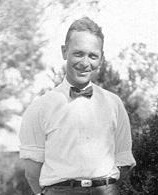
January brings us a number of prominent Koreshans. Perhaps the most prominent, at least from the view of a historian, was Claude C. Rahn. Claude was born in Baltimore, Maryland, in 1885. His family was one of the first to join the Unity in Estero. Thanks to Claude’s efforts we have a membership list, a short history of Dr. Teed and other information about the Koreshans.
As mentioned in previous months, the Community Current Events column which appeared monthly (for the most part) from 1916 on gives us an insight into the daily lives of the people who lived here. So, this month we feature a complete edition of the “Events” column from January 1922, 89 years ago.

OUR GREETINGS are somewhat belated, nevertheless, we wish you a Happy New Year just the same, and trust that fate will be kind to you. From the way many of our readers express themselves in their letters, we take it for granted that the nearest thing to their hearts is the Science of Universology. In a letter KORESH wrote to a friend concerning his doctrine he said: “It is the very Word, the presence of the Eternal One. While I write, the glory of the divine presence is so full, I wonder why the world so long refuses to imbibe this life.” Let us hope that a general awakening will take hold of the hearts of the people this A. K., 82, or as the world in general regards it, A. D., 1922, ‘for the knowledge of the truth as promulgated from The Guiding Star Publishing House.
Dr. Price, formerly of Chicago, but who for thepast year or more has been living at Rita, Fla., in the Everglades, made us a few days’ visit before the Christmas holidays. It was our good fortune while the Doctor was here to have an orchestra concert on the night of Dec. 22, in which he took part. He is an elocutionist and entertainer of decided ability, and despite his three score years and thirteen, he’s as youthful and agile as ever on the platform. The four numbers he gave us, three of them his own compositions, were something that will live long in our memory. The • first poem was concerning the Sunset in Florida. We have often remarked that our sunsets were beyond description, but we will have to modify our opinion somewhat since listening to the Doctor’s poem, because he has created a most beautiful setting and describes them in language most ornate.
The second number was an Irish letter compiled from letters he had written for Irishmen to their loved ones in old Ireland; needless to say he did the subject full justice if we may judge from the levic effect it had on the audience. The third was about the stars in the sky, and his grandmother’s conception of how they were produced. The Doctor remarked that since his study of Koreshan Science he has had to somewhat revise his early’belief concerning them.
The last number was “Darius Green and His Flying Machine,” given by request. The Doctor prefaced this number with a few remarks of his own experience during a flight he made in a flying machine in San Diego, Calif. The principal reason he gave for this ) flight was to satisfy his own curiosity concerning the ‘• horizon; theoretically, he knew from Koreshan Science (that the horizon came up to the level of the eye no matter how high he went, but this was the actual deJ monstration, and substantiated the Koreshan axiom: if the premise be proven, the conclusion is absolute by logical’ reasoning. To revert to “Darius Green,” we remember the Doctor saying that Mr. Trowbridge, the author, presented him with a gold medal for his rendition of it, stating that he had really gotten more out of it than the author himself had.
At the above concert Mrs. Guy Smith, of The Estero Inn, sang five numbers, each of which received a round of applause. Mrs. Smith is quite a favorite with Koreshan and Estero audiences, and her appearing is always looked forward to with great pleasure Prof. Schoedler played several numbers; Dr. Price remarked: “I never heard the piano played better.”
On Christmas eve, “Mrs. Wiggs of the Cabbage Patch” was presented on the screen to a large audience at the K. U. Art Hall. This play is in a class by itself, and is the best of its kind presented in Estero. It possessed a special interest to us, because we had the pleasure of conducting a party over the grounds last winter, and among them was the author of “Mrs. Wiggs,” Mrs. Alice Hegan Rice, and Mr. Rice, who is also the author of many works. The play was made possible through the efforts of Miss Bertha M. Boomer and Estero people, who contributed to this reel for this occasion.
Among other interesting pictures shown during the month were those made by the Ford Educational Film Co., describing how iron ore is brought from Northern Michigan in large vessels through the locks at Sault Ste Marie, passing the city of Detroit, and unloading at Ashtabula, Ohio, for the Pittsburg iron mills and other points. A reel, showing the process of transforming iron in its raw state to molten metal and made into ingots, and another reel where these ingots are reheated and rolled into bars the thickness of ribbons, was an inspiring sight to many in the audience.
For the last five or six years the Koreshan Unity has taken a most active part in the Lee County Fair held at Fort Myers, and on several occasions obtained first prize for the best decorated booth, besides numerous other prizes for our products. This year we are looking forward to an exhibit of our own here in Estero. This no doubt will enable hundreds of people to see Estero, and also give them an opportunity to learn more about our System and what we are here for. It is our intention in the near future to erect a permanent building for this purpose, that will enable us to promulgate Koreshan Universology with suitable models and diagrams that will illustrate the Cellular Cosmogony.
The Unity is the recipient of a gift from Messrs. Peter Campbell and Claude Rahn of New York City, of a 5075 h.p., De Lavergne Oil Engine, and the work of installing it will commence soon. We have had a 50 k. w., 2300 volt generator for some time, and as soon as the machinery is in running order we will be able to furnish all the departments with electricity, doing away with a great deal of overhead expense. We have also received from Brother Peter, as he is familiarly known to us, a 9 inch swing machine screw bench lathe, for the making of small parts. The Unity has a great deal to be thankful for in having such loyal and generous friends, whose great desire is to see this movement succeed.
The K. U. Orchestra gave a concert Dec. 31, and a rare treat was in store for all present. In addition to our usual audience there were about a dozen tourists from Naples and a number from Fort Myers We were very much pleased to have with us Mr. Atwood, an exceptionally fine singer, formerly of Chicago, but now of Fort Myers. Mr Atwood gave us three numbers; the name of the first we failed to get, but recall that it ranged quite high, possibly G above the staff. The next was “When the Bell in the Lighthouse Rings Ding Dong,” which took the opposite course, possibly to F below the staff; the last was Tosti’s “Good Bye,” a selection that was an exacting test for the voice, but of which the singer was absolutely master. He was accompanied on the piano by Mrs. Bishop, proprietress of the Graystone Hotel, Fort Myers. She is an excellent accompanist, and contributed much to the success of the singer.
By request Prof. Schoedler played Lizts’s “Hungarian Rhapsody,” and for an encore played “Moonlight on the Hudson;” needless to say, he did himself proud. Brother Robert Campbell played on the cornet “Home, Sweet Home,” with variations, in which he was encored twice. The orchestra music was also of a high class and was much enjoyed by all present.
At a recent offering of “Way Down East” at the Arcade Theater, Fort Myers, the music was furnished by five members from the Unity Orchestra.
We are pleased to record the visit of Mr. Leroy H. Bubbett of Chicago, who in the early days was connected with the Unity, coming in with his parents, Brother James and Sister Evelyn. Roy says “It’s good to get back and renew old acquaintances.”
Mr. and Mrs. Albert Miller, of Chicago, who are spending the winter in Fort Myers, were the guests of the Unity over the Christmas holidays.
Miss Hamilton, a niece of Brother Lou Staton, who teaches in the school of Fort Myers, spent the holidays at the Unity.
Mr. and Mrs. L. M. Boomer, of New York City, Mrs. Thomas and her two daughters, of Philadelphia, Pa., and Miss Doris Boomer and her brother Robert, of New Orleans, La., spent the holidays at Mirasol Grove, and it was the first time in years that Sister. Berthaldine has had her family around the festive board celebrating Christmas.

Categories: Monthly Feature.

Christmas 1943

There isn’t a whole lot mentioned in the materials that we have about Christmas. As usual, we rely mostly on the “Community Current Events” column which was published monthly in the “Flaming Sword”. Even though the Koreshans looked to Cyrus Teed as some sort of new messiah, they still claimed to be Christians. As I mentioned in a previous post, as time passed after Teed’s death in 1908 I believe that the Koreshans became more of a simple commune relying less and less on the teachings of Koresh.

So what was it like here in Estero at Christmastime? Here is the Community Current Events column from January 1944, which described the Unity in December of 1943.

Community Current Events
January 1944:

WELL THE WEATHERMAN must have been reading my page or listening to us singing and dreaming about a “White Christmas” for we came very near having one this year. Just about a week before Christmas it suddenly turned cold. Several mornings in succession there was a heavy frost and ice. The faucet in chicken yard was frozen up. I turned it on,— nothing happened but a gurgle. I turned it on and off and vice versa so many times till I finally did not know which way it was, so I gave it up and went about the other chores—which are many and varied. After a while the sun came up from behind the horizon and just before leaving the yard I looked about to see that all was well, and there to my consternation were the chickens happily splashing about in a pool of water several inches deep. Immediately I had visions of a flock of chickens down with roup, pneumonia, bronchitis, etc., and me in the role of a Red Cross nurse, but after a moment of petrified immobility I made a dash at them only to find that the water was quite warm as compared to the surrounding atmosphere, having just come from the bowels of a warm earth, and I came away, leaving them to enjoy their warm foot bath with the assurance that after all most of our fears are groundless, but I surely did nearly have heart failure.

Sister Etta Silverfriend left on the 16th for Savannah, Missouri, where she expects to remain for several week’s treatment.

Mr. and Mrs. F. S. Lewis came from Everglades on the 19th and will live permanently at their home here in Estero. Both Mr. and Mrs. Lewis have resigned from active business,—she as postmaster in which capacity she has served the public very creditably for many years. Mr. Lewis7 activities were many and varied he being interested and engaged with the Collier Interests, whose operations cover a wide field. We welcome these two as an asset to our community.

December 24—all day there had been a feeling of expectancy hanging over me, but nothing seemed to come of it until at the end of a long day of the usual round of chores and duties, well and faithfully performed, I hope;—the chickies tucked in and locked up for the night and so, feeling that I had earned a little relaxation I dimmed the light and turned on the radio. What a miracle it is,—and then it happened. I had tuned in on the Kate Smith program and from the radio came the vibrant but now suitably modulated voice of Miss Smith recounting the story of the patient little donkey, who, while on his way to the tanners after a long and faithful life of service, suddenly found himself the property of Joseph, purchased to carry his wife Mary, to the end of their journey,— Bethlehem. And while I listened to this Christmas story and heard again the story of the Shepherds, and the Wise men from the East, I lived again in memory or was it just imagination, that scene in the stable at Bethlehem. Almost I could hear the lowing of the cattle—the quiet munching of the beasts of burden; the patient Joseph ministering to Mary in her hour of travail and then the joyful, triumphant singing of the Angels,—”Glory to God in the Highest, on Earth Peace, Goodwill toward Men.”

And so, Jesus the Christ, child of immaculate conception, was born,—carried by the Virgin Mother to His predestined birth place not in pomp and splendor, but on the back of a docile and patient, tired little old donkey who had ‘served his worldly master faithfully and well, and to whom now was given this very great honor of partaking, ever so humbly, in the greatest of all miracles,—the birth of the Son of God, sent to the sinning world as a human link to retie it back to God the creator of all things good. And now at the end of nearly two thousand years of sinning and forgetting Him, the greatest of all woes has come upon us and it is now up to each and every one of us to set our own spiritual house in order or all the shot and shell; the bombs and all the other atrocities invented to wage this “Devil’s War” will have been in vain.

On the day before Christmas there was a general exodus of a number of the folks going off to visit relatives and friends over the weekend;—Sister Adah Price went to Fort Myers Beach to visit with Mr. and Mrs. Pulcifer; Sister Emily Bessemer went to Miami by bus to spend the holidays with her son Alton and family; Sisters Ella and Florence Graham accompanied Sister Hedwig Michel and Brother Laurie Bubbett to Miami to visit the Graham boys Robert and Lloyd. Sister Ella’s daughter, Mrs. Phillips, Mr. Phillips and their daughter Mrs. L. J. Norbury and granddaughter also came from Stuart, constituting a family reunion with four generations represented.

Mrs. Marguerite Head of Concord, N. H., has made several short visits to the Unity, recently. Marguerite came to the Unity, when a young girl, with her mother, Mrs. Page Borden, who contributed to THE FLAMING SWORD in the early days. She is stopping at Fort Myers.

Mrs. Lillian Rugg took dinner with us on Christmas Day.

And now at the end of a very eventful year we look forward to 1944 in the hope that before it ends peace will have been established throughout the world.

Categories: Posting.

Life In The Unity

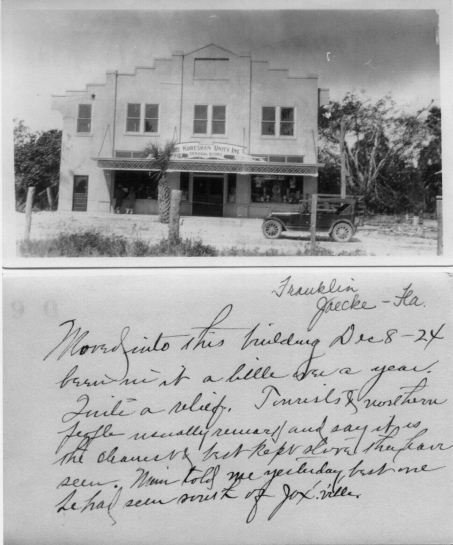
Anyone driving down US-41 is bound to see the “New Store”, which is probably the most visible part of the Historic Site, at least from the outside.

One of the store’s most interesting occupants was Franklin Jacke. Franklin’s life has been chronicled on this website previously.

Here is a copy of a postcard that Franklin sent to his mother. Life was apparently good, both for Franklin and for the Unity. He says:

“Moved into this building Dec 8.’24. been in it a little over a year. Quite a relief. Tourists and northern people usually remark and say it is absolutely best kept store thy have seen. Man told me yesterday, best one he had seen south of Jax’Ville”.

Of course, Franklin was the caretaker of the store. However, over time, he began to lose his eyesight and as mentioned in the previous post he sank into depression and took his own life.

Here is his obituary (courtesy of Genealogy Trails

Franklin Jacke

FORT MYERS NEWS-PRESS, April 1, 1936–Franklin Jacke, 61-year-old store keeper at the Koreshan Unity, committed suicide by drowning early yesterday morning in the Estero river. In a note addressed to the Koreshans, Jacke gave approaching blindness as the reason for taking his life. “I am about blind and can’t stand it any longer,” he wrote. When Jacke was missed at the store, the Koreshans headed by Brother George Hunt, started a search and first found the note which also contained instructions wehre to find the body. The sheriff’s office was notified immediately, and the body was located in the river by Deputy E. P. McAuley and State Officer Homer Klay. Deputy McAuley said that deep scratches on Jacke’s face made it appear that he had tried to claw out his eyes either before of after jumping into the water. He was drowned in a comparatively shallow spot and the body was recovered by wading and dragging with a garden rake. Jacke had been a member of the Koreshan Unity for 33 years, coming to Lee county to join the Estero community from his native home in Wisconsin. He is said to have relatives in Wisconsin. The text of the note follows: “Dear Folks: I am about blind, cannot see to do my work today. With all the business cares which no one knows, I am unable to stand this. I have gone to the river. Look for my hat on the point. I am so blind cannot see people in the store; just a dim outline.” The hat was found by Brother Hunt and nearby he discovered Jacke’s coat and a handkerchief neatly folded on the bank. He also left his watch and chain with his clothes. For many years Jacke had operated a general store which belonged to the Koreshan unity. The Koreshans told Deputy McAuley they would take care of the body themselves.
Submitted by Norrita Shepherd Moss

Categories: Posting.

December 2010

This month we take a look at life in the Koreshan Unity, long after the death of Cyrus Teed. There isn’t a whole lot of specific information about the beliefs and attitudes of the Koreshans during this time, but it seems clear that even though the “official” line still maintained the belief of the imminent return of Koresh, many, if not most, of the members of the Unity somehow believed that they were simply destined to live a life in community, which they had always done, and that they should continue to follow and study the beliefs and writings of Koresh, but few had any real expectation of Teed’s return.

With that in mind, life in the Unity in the 1930’s tended to lean more towards making it through the Depression and you will note that the tone of the following about prosperity sounds familiar. With that in mind, here is the “Community Current Events” column from January 1934, which would relay information about what took place in December 1933, 77 years ago this month:

Community Current Events – January 1934
By Alafae Stephens
————————————————————-
GREETINGS and salutations! Here comes 1934, which, all of us are hoping” will bring” the return of that almost-forgotten man, Prosperity. Pessimists tell us “He’s finished; he can’t come back,” but we don’t care much—just so Santa Claus isn’t dead. And if Santa moves his headquarters from the North Pole down to Florida, as has been rumored, we should have a jolly time the year around. Our Christmas doings must be reported the first thing, as they constituted the big occasion of the month, Sister Rose Gilbert, assisted by Sister Florence Graham, entertained the ladies of the Unity at “El Retire” on Saturday night, the twenty-third. A pleasant social evening was passed in listening to the radio, nibbling raisins, nuts, cookies, apples and candy, and drinking coffee. We had quite a big time of it on Christmas, with pumpkin pie and everything. Mrs. Marie McConnell of Tampa sent a box of large, luscious apples, and Mrs. Lovelle Ahrano, also of Tampa, made us a present of some paper-shell pecans, which were immensely enjoyed. Mrs. L. C. Dillard of Washington, D. C., sent individual cards to the members, as she does every year, and many other friends tendered greetings, adding to the enjoyment of the day. Oranges from Brother Peter Blem’s young trees were a welcome item. Dr. and Mrs. A. E. Berry, both practicing physicians, of Tampa, and Misses Lydia and Marian Pierce took Christmas dinner with us. Dr. and Mrs. Berry’s son, Richard S. Berry, was here for a short while about five years ago, at which time he wrote a thesis on Koreshanity as part of his work at Gainesville University. Sisters Berthaldine and Bertie Boomer entertained with a party on Christmas night at their home in Mirasol Grove. The place was appropriately and attractively decorated; under a small Christmas tree were grouped favors for the guests, consisting of packages of candy, nuts, and fruit-cake. Sandwiches, coffee, and fruit punch were served, after which the assembly sang Christmas carols and other old favorite songs. The close of the party marked “the end of a perfect day.” Mr. Henry Moreland and Floyd visited here on Sunday, November twenty-fifth. At the evening services, Floyd favored us with a flute solo, accompanied on the piano by Sister Edith Trebell. This was in addition to a violin solo played by Brother Laurence Bubbett; these violin solos we have come to count upon as a regular feature of the meetings. On Thanksgiving Day, Sister Bertie Boomer gave a house-warming at “The Hermitage,” the new cottage she has had constructed on the road to the Seaboard station. More than fifty guests were in attendance, many of whom brought presents for the house. Sandwiches, doughnuts, apples, and coffee were served to the company. Mrs. Mary Iden, Sister Florence Graham, and Brother Alien Andrews motored to Miami on Friday, December first, where they visited relatives and friends until Monday. Brother Max Arendt returned on the tenth from his sojourn in the North. After seeing the Chicago Exposition, he visited relatives in Milwaukee, then made a trip to southern California for a short visit with friends there. He was glad to get back to Florida, finding its mild temperatures a welcome change from the severe northern blizzards. ‘ Harry DuBois has recovered almost fully from his attack of pleurisy, which, laid him up about a week. That was as long as. Doctor Frank Wilson would allow him. Brother Claude Rahn ran the filling station while Harry was indisposed. Brother John Watson was the guest of honor at a surprise party held in the bakery on the evening of the eleventh, the occasion being his, birthday anniversary. A chicken dinner with all the trimmings was enjoyed by the guests. Brothers Alien Andrews and Laurie Bubbett went to Miami on Friday the fifteenth, returning on the eighteenth. Brother Laurie’s absence left us without a violin solo for the Sunday services, but we, had an excellent vocol solo by Brother David Richards. Misses Meta Monsees, Lydia and Marian Pirce, and Genevieve Bisbing v/ere visitors here on Sunday the seventeenth. Mr. and Mrs, R. B. Stevens and son David, Miss Hilda Cunniff, Mr. Edw-ard Theegarten, and Brother Henry Silverfriend went on a boat party to Hickory Island, where they had a picnic lunch on the beach. They were lucky fishermen, making a good catch by trolling. Sisters Evelyn Bubbett, Ida Fischer, and Cora Stephens and Brothers Henry Silverfriend and Claude Rahn motored to Coconut on the eighteenth where they visited Mrs. Mary Johnson, Mrs. A. L. Smith, and Erwin Fischer and family. Mrs. Edith Johnson of Minneapolis has arrived to spend the winter season with the tea-garden ladies, Mrs. Camphausen and the Misses Lindberg. Dr. John Seebold comes from LaBelle nearly every Sunday and attends the religious services. Brother John Grier has been uncovering a lot of territory in the vicinity of the laundry, making an improvement in the looks of the place. He finds that bad weeds, grow rapidly even in dry weather. Brother Laurie has been taking his “daily dozens” in clearing the grounds about the Art Hall, and Brother George Hunt’s good work of the same kind continues.

Categories: Monthly Feature.

November 2010

From the Koreshan Archives: — November
— November brings us to the birthdates of two of the most prominent Koreshans, at least with regard to the present day State Historic Site. November 12 is the 160th birthday of Berthaldine Sterling Boomer,one of the very first followers of Dr. Teed. Her name also figures prominently in the history of the State Historic Site since her home, built by her son, Lucius Boomer, is the focal point of the latest efforts to preserve Estero. The house once known as Mirasol Grove still stands, hidden by the growth, at the corner of US-41 and Broadway. The home was sold to the State and Lee County to be preserved. Berthaldine, who died in the house in 1935 was, as already mentioned, an early follower of Dr. Teed. She came to Estero with the second group in January of 1894. Mrs. Boomer did a great deal of writing for various Koreshan publications, including the Flaming Sword.
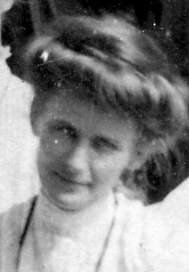
The other prominent Koreshan was Lillian “Vesta” Newcomb who was born in Stockton California on November 19, 1878. Lillian, who was renamed “Vesta” by Koresh, came to Chicago with her mother, Hattie, who had become a widow, and her brother, James. They arrived in Estero in 1894. Even though Hedwig Michel was the last Koreshan, Vesta was the last of the originals. That is, she was the last of the original Estero settlers. Vesta served as a maid to Victoria (Annie Ordway) and was a student of Koresh, a lover of poetry and books. She also served as a helper to her mother who ran the Koreshan dining room. She was a teacher and even learned to operate the linotype machine at the Guiding Star publsihing house. She also befriended the Boomer family and was a frequent visitor to Mirasol Grove. George Boomer, grandson of Berthaldine, donated almost 20 acres of land near the boat ramp in the Historic Site in Vesta’s memory. Vesta wrote of the ordeal of those early days. she said:

“We tackled with the wind this way and that way,and we were all sick. At Mound Key we were rowed in a towboat to Halfway Creek where they pushed north through the bush carrying our belongings and a parrot in a cage. We finally reached an ox-team trail, turned south over a rustic bridge, and there we established our settlement. We pitched our tents and slept for 10 months on the ground. We cooked and ate around a bonfire. Everyone did his share of the work. ((1))

Vesta died on April 8, 1974.

In the spirit of the season… Yesterday was Halloween and of course, every year there are stories about ghosts and cemeteries. The News-Press had an article over the weekend about cemeteries and they mentioned the Korehsan cemetery located inside Pelican Sound. One of the residents said:

“It’s right smack in the middle of our neighborhood.”

Well, I’m sure they meant it in a nice way, but those buried Koreshan were there a long time before the neighborhood was. The Koreshans were also referred to as “Kooks“. Again, I’m sure the remarks were well meaning, but looking back with 20-20 hindsight, a lot of people looked like kooks. The Koreshans were true pioneers in southwest Florida and regardless of some of their off beat beliefs (by today’s standards), they brought culture and civilization to this area, which is NOT to day that the Seminoles and others did not, but Koreshans brought with them their music, literature and other valuable contributions to life in this area.

  1. Quoted in the “Fort Myers News Press – 18 October 1979. AC-0093 []

Categories: Monthly Feature.

Estero Historical Society

This article is from the Fort Myers News Press

The Estero Historical Society will have its monthly meeting at 2 p.m. Monday (October 11) at the Estero Community Park’s Recreation Center, 9220 Corkscrew Palms Blvd. (off the south side of Corkscrew Road a mile east of U.S. 41).

Information on upcoming events and progress on restoring the historical houses will be discussed. The public is invited.

Ruth Campbell Mason will present information on the Campbell family’s life in early Estero. The Campbells were members of the Koreshan community.

Also, the historical society will hold a fundraising Texas-style barbecue from 5-7:30 p.m. Oct. 23 at Estero Community Park.

Homemade beef brisket, drinks and dessert will be served. The cost is $30 for individuals and $50 for couples.

The public is invited. For more information, contact Jean Pryal at 498-5296 or jpryal4@comcast.net.

The proceeds will be used to help restore the 1904 Estero School. The school and circa 1906 Hall-Hanson-Collier House were moved to the park from Highlands Avenue in Estero in 2009.

Restoration of the Hall-Hanson-Collier House will be completed in December. Work on the school and ramp connecting the two will start next year as funds become available.

Categories: Posting.

October 2010

From the Koreshan Archives: — October 2010

   —  October brings us the busiest month of the year with regard to the Koreshan story. The premier event is, of course, the birthday of Cyrus Teed, a.k.a. Koresh who was born in Delaware County New York on October 18, 1839. Quoting former Ranger, Peter Hicks, who’s biography of Dr. Teed appears on this web site:

Cyrus Read Teed was born on October 18, 1839 near Trout Creek, Delaware County, New York. He was the second son born into a family of eight children. As early as 1637, Teeds had lived in the Massachusetts Bay Colony. By 1757, they had migrated to Tompkins township in Delaware County, New York, settling near Trout Creek in an area that was known as Teedsville, fifteen miles from Walton. His father, Jesse Sears Teed, was born there on June 24, 1814 and died at the Koreshan Unity home in Chicago, Illinois on March 9, 1899. On his mother’s side, he was directly descended from John Read who came to America in 1630, settling in Rehoboth, Massachusetts. His great grandmother Lydia married the Reverend Oliver Tuttle of Bristol, Connecticut. His mother, Sarah Ann Tuttle was born on October 27, 1815 in Bristol, Connecticut and died at Moravia, New York, October 25, 1885. Shortly after Cyrus was born, the family moved to New Hartford, New York on the land of grandfather Oliver Tuttle. At the age of eleven, Cyrus quit school and went to work on the tow path of the Eire Canal. His family wanted him to become a Baptist minister like his grandfather Tuttle, but Cyrus chose to follow another relative and began studying medicine with his uncle, Dr. Samuel F. Teed ( a twenty-five year old allopathic physician) in Utica, New York. At this same time on April 13, 1859, he married his second cousin, Fidelia M. Rowe of Merideth, New York. Delia was the daughter of William and Polly Maria Tuttle Rowe.

   This month also marks the birthday of one of the most prominent Koreshans.

“Professor” Ulysses Grant Morrow, the man who “proved” the Cellular Cosmogony. The KSHS Archives has numerous references to Prof. Morrow. He was born in Kentucky and later moved to Missouri. It is unclear when or where he joined the Koreshans, however, the Rahn Membership List shows the following: Ulysses G. Morrow; Born: 26 Oct 1864 in Barren Co., Kentucky; as a boy moved with his parents to Unionville, Missouri, in 1885. He had a Ph.D. from “College of Higher Science,” Chicago; withdrew from the K.U. at Estero, January 31, 1909, about a month after the death of Dr. Teed, in December 1908. This resignation must have actually taken place earlier than that, however, since the Flaming Sword of December 15, 1908 mentions tht changes will be taking place in the publication due to “the resgination of Professor Morrow… While he belonged to the Unity he authored part of the book The Cellular Cosmogony as well as editing the Flaming Sword and the Salvator and the Scientist. However, when he eventually came to a disagreement with Dr. Teed and he left the Koreshan Unity, his writings remained in the book, only without credit. Writing to a Koreshan in 1938, Morrow said: “When I withdrew from the Koreshan work, I made this declaration… ‘I will follow no man…” He also said “I have nothing to say against him. (Teed) …I became conscious of the fact that he was losing that high conception (of righteousness) and was failing in various ways, as his last few years fully attest. …If I passed him in progress, it was his fault” He also said that when he left he took bound copies of all his writings, but later discarded them because of his desire to begin anew. He worked as a linotype operator in order to make a living. Morrow died in New Orleans on September 11, 1950.

Categories: Monthly Feature.